

Ruth Melcho is a real estate agent at Keller Williams. She works across residential, commercial, land, and mobile homes throughout the Bay Area, and she'll tell you that's not a hedge or a fallback. It's the strategy.
"I'm a connector at heart," she says.
Real estate, the way Ruth thinks about it, is one of the most consequential decisions a person makes in their financial life, both creating wealth and protecting it. So she built a practice that doesn't pick one lane and call itself a specialist. Instead, it picks the right specialist for the client in front of her. And that means staying fluent across all of them.
The Santa Rosa Story
A pair of first-time homebuyers came to Ruth with a modest but workable budget. The plan was a starter home that, a few years later, would convert into a long-term rental and have meaningful value growth. First home and future investment in one.
When they sat down for the discovery consult, they told Ruth they were eyeing Santa Rosa. They felt they could get more house for their money there, which isn't necessarily untrue.
Ruth asked more discovery questions. Did they have family there? A lifestyle draw? Some specific affinity for the area? They stopped and looked at her.
Nothing. Just home prices.
Both of them currently worked in the South Bay. Their family lived there. Their lives ran on the south side of the Bay. The Santa Rosa plan was math, not life. And once Ruth started laying out the actual math, the picture shifted: the perceived home purchase savings and their way of life would be eaten, and then some, by commute time, the cost of life dragged along the 101, the distance from family, and a slower local home value appreciation rate than the area they already lived in.
A few months later, they closed on a beautiful single-family home in the South Bay, in their budget and much closer to family, in an area whose median home appreciation percentage runs 43% higher year-over-year than where they'd originally planned to buy.
"They get to live a more balanced life," Ruth says, "while owning in an area that has a much stronger appreciation for their future home values."
The thing she's clearest about is what happened in the discovery session itself. She had no hesitation pressure-testing the plan with them.
"It's my job to talk to people about their goals," she says. "And to make sure their plans actually align with those goals in reality. If Santa Rosa would have been the right answer for them, that would have been fantastic. But based off what they told me, I had concerns."
"It's my job to talk to people about their goals. And to make sure their plans actually align with them."
Ruth MelchoWhy She Doesn't Pick a Lane
For most agents, breadth is a liability. The standard playbook says pick one corner of the market and own it. Ruth read the playbook and decided to do the opposite, on purpose.
"I work in a wide range because that also allows me to connect my clients with the specialists when needed," she says. "But not just a specialist. The right specialist for that specific person's needs."
The wide range isn't grabbing whatever comes along. Ruth's invested significant time, effort, and resources to gain usable knowledge and experience across these realms, so she can serve and advise clients at a high level, and so she can pair them with the right fit when their needs get more specialized.
"I can't properly refer or know what to ask if I don't have the working knowledge myself," she says.
So she spends real time in education, in transactions, and in the company of professionals she's already vetted as quality. And when a client does get aligned with a specialist, she stays hands-on through the transaction as appropriate. It's not a hand-off and hope.
Even within commercial real estate, she points out, the lanes are deep. The best person for getting raw land through entitlements and developed into a retail center may be a totally different operator than someone who transacts large apartment complexes. A well-meaning but inexperienced residential agent who picks up a commercial lease deal is not the same as someone embedded in that asset class. The licensing overlaps; the actual expertise doesn't.
So Ruth keeps the door open across all of them. Not to be the specialist herself in every case, but to know who the right one is.
"I don't pick a lane so I can maintain and offer strategic partnerships as my clients need them," she says. "Always, the North Star is what my client needs."
She's done deals from a piece of land for under ten thousand dollars all the way up to multimillion-dollar purchases. The structure stays the same: relationship first, team behind her, client's actual goal at the center.
What Outsiders Get Wrong About Bay Area Real Estate
If you ask Ruth what most people miss about the Bay Area's residential real estate market, including a lot of people who live here, her answer comes in three pieces.
The first is the trend line. It's easy to watch the national news and assume the same story applies here. It doesn't. Pull up a Bay Area value graph of the past decades and start at the left, she says. The line's pattern fluctuates, but ultimately trends up over time. New lows are typically cyclical and temporary, and more often than not sit above what used to be the ceiling. Yesterday's high becomes tomorrow's floor.
The second is the cost of money. In most markets, mortgage interest rates are the dominant variable on what buyers can afford. In the Bay Area, the stock market can have more impact on purchasing power and price action than interest rates, especially in the tech-adjacent areas of the Bay. When a client has a real strategy and a good lender, rates stop being the deal-breaker the headlines make them out to be. Decisions made off headlines and what your neighbor said cost more than the rate ever does.
The third is the macro picture. Most people think of the Bay Area as a region. Ruth thinks of it as something larger.
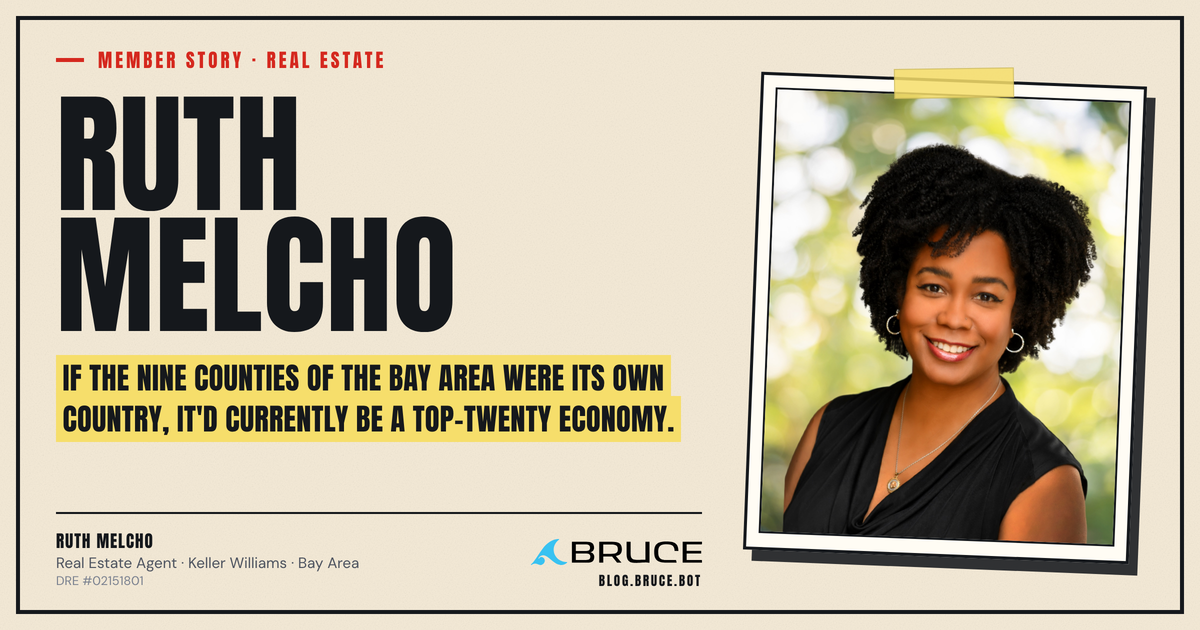
"If the nine counties of the Bay Area were its own country," she says, "the Bay Area would currently be in the top twenty economies in the entire world."
Strong economy. Mild weather. Constrained geography. There's a reason values hold and rise the way they do. And, she's clear: anyone who buys right and holds through the ups and downs has, in her experience, a strong outcome ahead.
"If the nine counties of the Bay Area were its own country, the Bay Area would currently be in the top twenty economies in the entire world."
Ruth MelchoThe Right People Around the Table
The partners most agents reach for first are other real estate agents, and Ruth has those connections too. But the partners she's looking to add to her network are the ones who get overlooked: financial planners and estate attorneys. They're already in the room when their clients are making the decisions she can add value to, and they're not the introductions most agents are chasing.
Financial planners see clients' wealth in motion, sometimes before real estate ever enters the conversation. They work with their clients to know when a client is positioned to buy or invest, and they know when it's time to liquidate a property to fund something else. They need someone to handle that real estate piece thoughtfully, and Ruth is the operator they can hand it off to. The relationship runs both directions: when Ruth's clients are growing financially, she connects them with planners who can help them deploy those gains.
Estate attorneys are the ones, in Ruth's words, "not enough people talk to early enough." Too often, they're called upon at the moments families don't want to think about: probate, settlements, things falling apart in ways nobody planned for. Emotions run high. Decisions, sometimes including real estate, need to be made. Ruth's role in those situations isn't transactional; it's the level-headed hand the family needs walking into the next chapter.
"I offer my expertise, resources, and patient demeanor," she says, "to situations where everyone involved needs level-headed guidance and execution."
A cold call has none of this context. An intro from a planner or an attorney who already understands the family's situation does. Those are the introductions Ruth welcomes, and is able to serve at a high level.
Relationships, Not Transactions
Ask Ruth what's changed about her business since she settled into this approach, and the answer doesn't come in deal counts.
"I've never been somebody who's purely transactional," she says. "It's always about the relationship."
The proof shows up in patterns. Clients come back for second purchases. And new clients keep arriving through introductions from past ones. Not one loyal champion sending everyone, but a steady set of past clients who kept her in mind. The math is harder to point at than a closing volume, but the structure compounds in ways one-and-done agents never see.
"It's not just about the size of the deal." That's the line that explains the rest of it. Same conversation, same care, same team-building approach for a ten-thousand-dollar piece of land as for a multimillion-dollar acquisition.
"It's about what their needs are. And making sure I can help them, or align them with the best help, to get their needs taken care of."
Most agents work the deal. Ruth listens, advocates, aligns. The lane is never the point. Her clients landing on a path to success is.