
How Watching Her Family Lose Their Home Shaped Everything Helen Chong Built Next
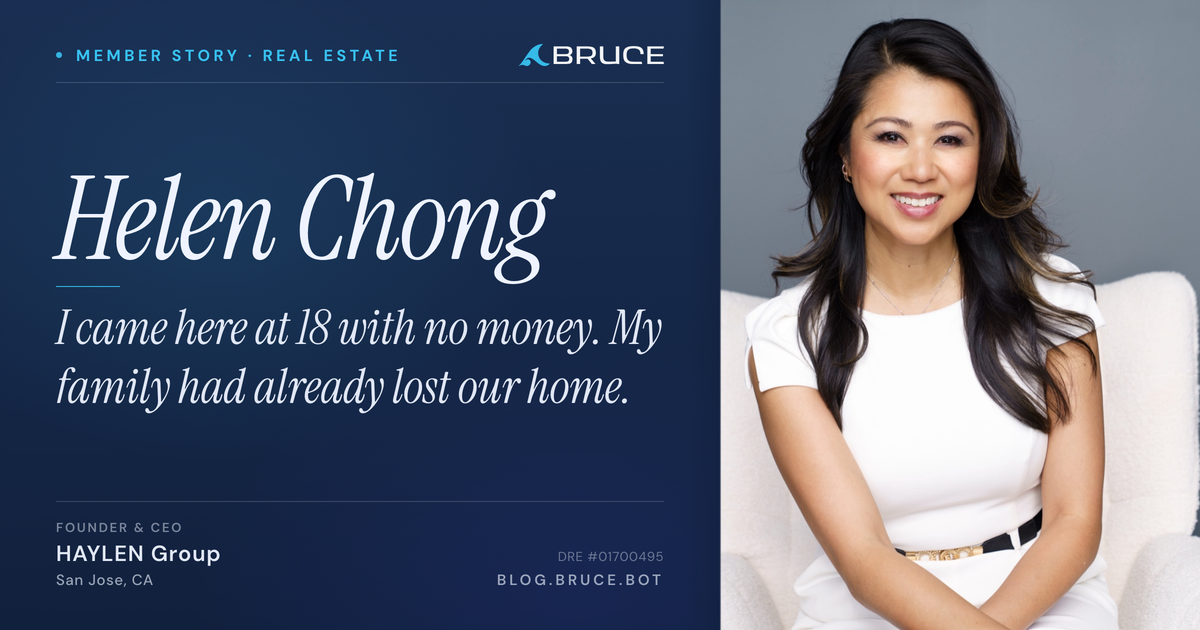
Helen Chong came to America at 18 alone. Her family had already lost their home. Today she's a top 1.5% real estate professional in the country, building security for first-generation buyers, the kind she had to invent for herself.

Helen Chong is the founder and CEO of HAYLEN Group, a Bay Area real estate practice based in San Jose. She's ranked top 1.5% of real estate professionals in the country, and has been for years. Before any of that, she was eighteen years old, on a plane from Hong Kong to the United States, alone. No family here. No money. Her own family had already lost their home back home when their business failed.
The work she does today is shaped almost entirely by what those first years without a home and family felt like.
A Home, Lost
When Helen's parents lost the home they'd been so proud of finally owning, the family didn't just lose a house. They lost the stability around it.
"It created so much instability within the family," she says. "My parents fought a lot. Eventually they left to work in another country. Coming home to an empty house every day by yourself, going to sleep by yourself, it wasn't a good feeling."
"It really made me realize how important it is to have control over financial wealth, financial security. I really wanted to make sure that my own family in the future, we don't have to worry about that."
Helen Chong, HAYLEN GroupThat experience, more than any single career decision after, is what shapes her practice today. Most realtors will tell you about the deal that made them. Helen will tell you about the loss that did.
From Pensions to Real Estate
Helen's first career in the U.S. wasn't real estate. She was a pension analyst, reviewing the retirement portfolios of large companies: the funds employees would draw from after thirty or forty years of work.
She noticed two things that bothered her.
First, the numbers didn't always add up. The reports she signed off on were generated by junior analysts working at speed, and the underlying valuations weren't always "accurate."
Second, and this is the one that stuck with her, the people whose retirements depended on those portfolios had no control over how the stock market behaved in the year they happened to retire.
"I had met people who lost 65% of their portfolio because that year, that's when the stock market crashed. That's something very opposite from what I really believe in: taking control of your retirement."
Helen ChongShe walked away from pension analysis and into real estate. Not because the upside was bigger. Because the control was real.
"My real estate investing result is based on my own control. I can go fast or go slow. I don't believe in investing too fast. You invest slowly, one at a time, until it stabilizes, then you go to the next thing."
The pivot, in retrospect, wasn't about money. It was about a refusal to repeat what she'd watched her family go through, on a different timeline, in a different kind of household.
A Client Who Built a Future, One Property at a Time
One of Helen's longest client relationships is with a woman whose mindset mirrored her own, an entrepreneur and mother who came to Helen with a clear plan: build wealth, deliberately, through real estate.
"She bought her first condo as an investment property. Then a single-family. Then three units. Then five-plus units. She probably owns hundreds of units now."
Before her children even reached high school, the portfolio was already funding their future. Both kids went to one of the most prestigious boarding schools in the country. Both are now in college.
"I remember when she first started, she said: 'Helen, I hope you can really help me out, because my children's future college tuition is going to come from these real estate investments.' I was part of that journey with them."
That's not a transaction. That's a fifteen-year compounding relationship, the kind of advisor work most agents don't stay around long enough to do.
What She'd Tell a First-Generation Buyer
Helen works with a lot of immigrant families and first-generation buyers, people whose parents never owned property in this country. The questions are the same every time: Will this work? Am I being realistic? What if something goes wrong?
Her advice is structural, not tactical.
"Find someone who is going to fight for you. Not just somebody who wants to make a transaction work."
She has a specific perspective on the growing trend of high-volume and discount-focused real estate models.
"My approach has always been more relationship, advisory and number-driven. Some models are built around handling a large number of transactions, while I prefer to spend more time making sure my clients truly understand the risks, opportunities, and long-term impact of their decisions through my analytical rigor, no matter whether it's a residential or commercial real estate transaction. For me, it's never just about closing volume. It's about making sure the client feels informed, protected, and supported throughout the process."
A real buyer search takes three to six months, sometimes a year. Due diligence on every property. Running all the numbers, repeatedly, so the buyer makes the decision rationally, not emotionally.
"Buying a home is very emotional. I don't think a lot of people understand how emotional it is when you find the home you think is the one. You don't want to be making decisions you don't fully understand."
Helen ChongFor a first-generation buyer, the difference between a fight-for-you agent and a transaction agent is the difference between buying a home and owning a future.
What She's Actually Building
If you ask Helen what she does for work, she says she's a realtor. If you ask her what she's building, the answer takes longer.
There's the book, Power to Change Lives: How to Leverage Life's Obstacles to Reach Financial Success. It began as a way to share the life lessons, struggles, and values that shaped her journey with her own children.
There's the Grocery Assistance Program, which she personally funded and started during COVID and the California wildfires.
There's the speaking circuit: Forbes Speakers Network, USA Today, KRON4, Silicon Valley Business Journal "Woman of Influence."
But none of those are the answer to the question.
"I am not working towards being the number one agent in the country. I just love what I do. I want to help people who feel lost in real estate. I want to be the go-to person for them when they need confidence to move forward."
Helen ChongThe book started as a private message to her own children. The grocery program started during a moment of national crisis. The speaking is her teaching, in public, the curriculum she had to invent for herself: that whatever you're starting with, however little you have, the path forward is determination, persistence, and a refusal to let your past define what you build next.
That's what she's building. Not just an agency, but a legacy, the hope that by sharing her story, she can bring strength, perspective, and encouragement to someone who may feel as hopeless or uncertain as she once did.